Indonesia’s fast-moving consumer goods (FMCG) landscape is undergoing a notable shift toward health-conscious and lifestyle-driven beverage consumption. To capture insights into this evolving market segment, Snapcart conducted a nationwide online survey (n = 1,707 respondents) evaluating consumer habits, brand funnels, purchase channels, and underlying purchase drivers within the branded liquid plant-based milk market. The findings reveal a highly engaged market where routine consumption is well-established and long-term category retention is remarkably strong.
Respondent Profile
Female consumers represent the vast majority of category participants (70%), while male represent 30%. The age group is overwhelmingly concentrated among Gen Z and Millennial cohorts, with respondents aged 18–34 comprising 69% of the total sample (36% for 25–34 and 33% for 18–24). Mature adult consumers aged 35–44 represent a secondary segment at 21%, while older adults (45+) and teenagers (<18) form smaller niche bases at 7% and 3%, respectively.
Liquid Plant-Based Milk Consumption Frequency
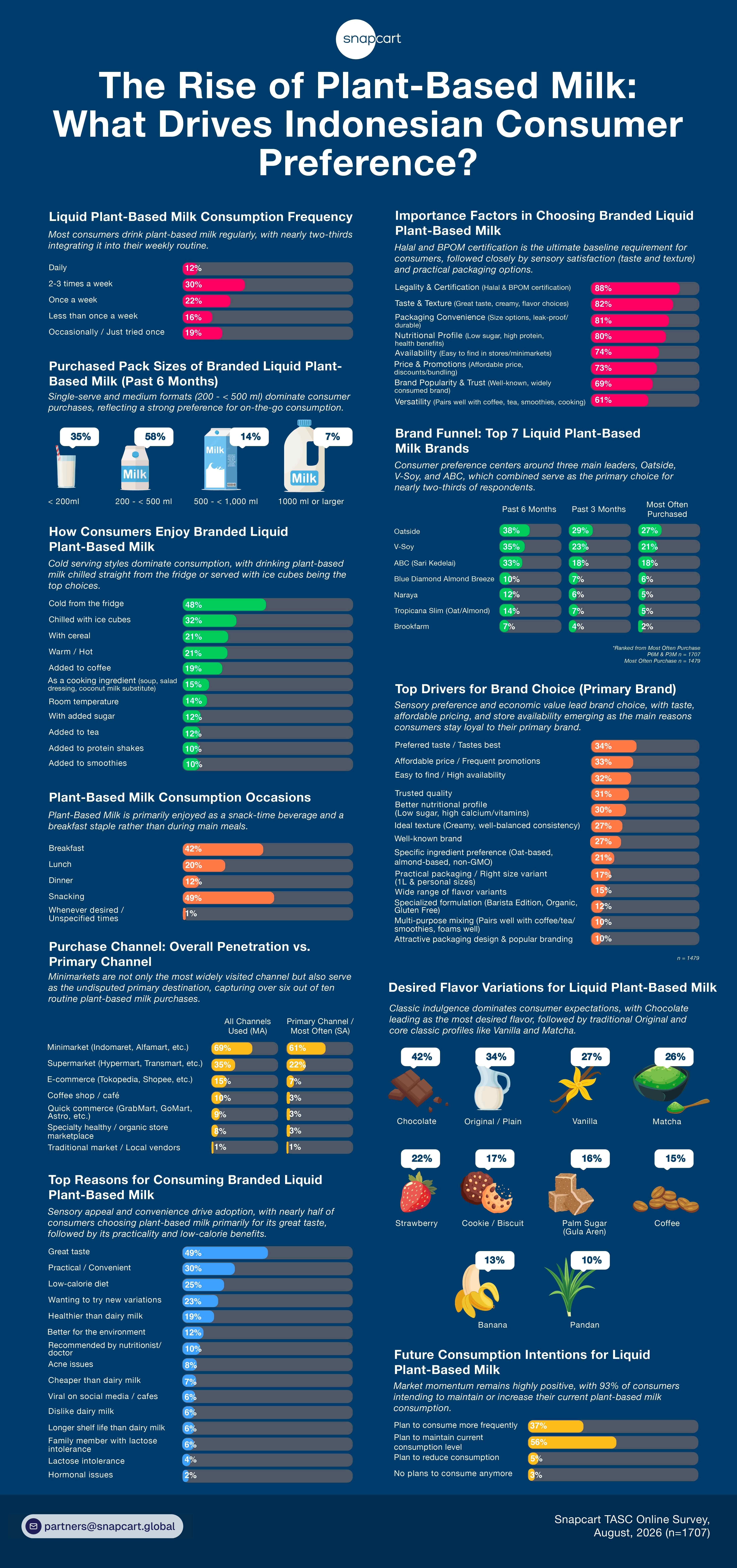
Routine consumption is already well-established, with 64% of respondents consuming plant-based milk weekly or more often (combining 12% daily, 30% 2–3 times a week, and 22% once a week). On the other hand, non-routine or casual drinkers represent the remaining 36% of the market, comprising those who drink it less than once a week (16%) and occasional/trialists who have only tried it once (19%). This balance highlights a dual opportunity for FMCG players: driving retention among the high-frequency core (64%) while designing targeted sampling and promotional levers to convert the sizeable pool of occasional trialists (35%) into regular buyers.
Purchased Pack Sizes of Branded Liquid Plant-Based Milk (Past 6 Months)
Package size choices illustrate the balance between on-the-go personal consumption and home stocking. Evaluating packaging formats purchased over the past 6 months (multiple answers) indicates that personal-consumption formats dominate purchase history. Medium single-serve packs (200 – < 500 ml) lead significantly at 58%, followed by small formats (< 200 ml) at 35%. In contrast, large multi-serve family packs capture lower purchase shares with 500-<1,000ml chosen by 14% and 1,000 ml or larger capture only 7% of respondents.
How Consumers Enjoy Branded Liquid Plant-Based Milk
Consumer serving choices demonstrate the product’s versatility across different drinking habits and culinary uses. Examining typical preparation and serving preferences (multiple answers) reveals cold serving methods represent the primary consumer touchpoints, led by drinking cold from the fridge (48%) and chilled with ice (32%). Beyond standalone cold drinks, respondents utilize plant-based milk across diverse applications: 21% pair it with cereal, 21% consume it warm/hot, 19% add it to coffee, and 15% use it as a cooking ingredient (e.g., coconut milk substitute). This highlights high product versatility, showing that plant-based milk integrates into both direct drinking and functional food/beverage preparation.
Plant-Based Milk Consumption Occasions
Understanding key dayparts reveals when plant-based milk fits naturally into daily consumer routines. Identifying primary consumption moments throughout the day (multiple answers) highlights that consumption is tightly clustered around two major dayparts: Snacking (49%) and Breakfast (42%). Heavy mealtime occasions show substantially lower penetration, with Lunch at 20% and Dinner at 12%. Consumers frequently cross over between morning routines and mid-day refreshers, confirming that plant-based milk acts primarily as an accompaniment or standalone energy boost rather than a meal replacement.
Purchase Channel: Overall Penetration vs. Primary Channel
Retail channel usage highlights the difference between casual discovery touchpoints and routine purchasing hubs. Comparing total channel reach (multiple answers) against primary channel loyalty (single answer) shows minimarkets are the undisputed retail backbone of the category, visited by 69% of consumers overall and chosen by 61% as their main routine purchasing destination. Supermarkets capture 35% overall touchpoints and 22% primary share. Specialized channels exhibit a clear conversion gap: Coffee shops (10% vs. 3%), Quick Commerce (9% vs. 3%), and Specialty Healthy/Organic Stores (8% vs. 3%) demonstrate meaningful trial and touchpoint presence, but primary volume conversion overwhelmingly collapses back into modern convenience retail due to physical accessibility.
Top Reasons for Consuming Branded Liquid Plant-Based Milk
Category adoption is driven by a mix of sensory pleasure, health perception, and dietary requirements. Exploring consumer motivators for choosing plant-based options (multiple answers) demonstrates sensory taste and lifestyle convenience drive category entry far more than clinical needs. “Great taste” leads all motivators at 49%, followed by “Practical / Convenient” (30%), “Low-calorie diet” (25%), and “Wanting to try new variations” (23%). In contrast, medical/physiological drivers rank near the bottom: “Acne issues” stands at 8%, while direct “Lactose intolerance” accounts for only 4%. Broad lifestyle appeal like flavor, convenience, and light wellness is the core engine of category adoption.
Importance Factors in Choosing Branded Liquid Plant-Based Milk
Brand acceptance and purchase decisions are tied directly to tangible quality, regulatory, and commercial factors. Assessing key selection criteria (Top 2 Box) illustrates that regulatory assurance is the non-negotiable entry ticket, with “Legality & Certification (Halal & BPOM)” scoring the highest importance rating at 88%. Right behind the regulatory baseline are product-execution factors: “Taste & Texture” (82%), “Packaging Convenience” (81%), and “Nutritional Profile” (80%). Commercial attributes such as store availability (74%) and pricing/promotions (73%) also command high importance, indicating that brands must deliver on compliance, sensory quality, and distribution simultaneously to win market share.
Brand Funnel : Top 7 Liquid Plant-Based Milk Brands
Brand Funnel Analysis (Ranked by Brand Used Most Often/BUMO)
An evaluation of consumer brand interactions across sequential funnel stages over time (P6M & P3M: Multiple Answers | BUMO: Single Answer; ranked by BUMO) shows clear patterns in conversion and retention:
Past 6 Months
Category entry is led by a strong trio: Oatside (38%), V-Soy (35%), and ABC (33%). These three brands dominate initial trial and awareness, creating a substantial lead over second-tier competitors like Tropicana Slim (14%), Naraya (12%), and Blue Diamond (10%).
Past 3 Months
Moving down to recent consumption, Oatside (29%) maintains the highest quarterly retentiveness. However, the drop-off rate from P6M to P3M begins to differentiate market efficiency. While Oatside retains 76% of its 6-month users into recent 3-month usage, challenger brands like Tropicana Slim and Naraya experience a steep 50% drop in active quarterly buyers (falling from 14% to 7% and 12% to 6%, respectively).
Brand Used Most Often
Final brand loyalty is heavily concentrated around the top three players, which together dominate 66% of primary consumer preference. Oatside leads the market at 27% BUMO, followed closely by V-Soy (21%) and ABC (18%). Notably, Blue Diamond Almond Breeze demonstrates exceptional funnel efficiency: despite a lower initial trial base (10% P6M), it successfully converts 60% of its trialers into loyal primary users (6% BUMO), outranking Tropicana Slim (5%) and Naraya (5%) at the core loyalty stage.
Top Drivers for Brand Choice (Primary Brand)
Brand retention depends on balancing product satisfaction against market friction. Uncovering core reasons for staying loyal to a primary brand (multiple answer) yields brand switching or retention is decided by a tight competition between sensory appeal and commercial friction. Preferred taste leads brand choice drivers at 34%, closely trailed by affordable pricing/promotions (33%), store availability (32%), and trusted quality (31%). Secondary drivers like specialized formulation (12%) or packaging design (10%) play supporting roles. Consumers remain loyal only when superior taste is backed by reasonable pricing and widespread retail distribution.
Desired Flavor Variations for Liquid Plant-Based Milk
Flavor expectations reflect consumer interest in both traditional staples and lifestyle-driven options. Gauging consumer demand across prospective flavor offerings (multiple answers) shows that indulgent and familiar flavor profiles capture the highest consumer appetite. Chocolate is the most requested variant at 42%, outperforming staple Original/Plain (34%) and Vanilla (27%). Modern lifestyles demonstrate strong demand: Matcha reaches 26%, Strawberry hits 22%, Cookie/Biscuit captures 17%, and Palm Sugar (Gula Aren) sits at 16%. Portfolio expansion beyond unflavored bases is crucial for capturing incremental volume.
Future Consumption Intentions
Long-term growth prospects are shaped by consumer intent to stay in or expand within the category. Projecting long-term category trajectory reveals that long-term category sustainability is exceptionally robust. A total of 93% of consumers intend to maintain (56%) or increase (37%) their current consumption frequency. Conversely, active churn intent is minimal, with only 5% planning to reduce consumption and 3% planning to stop. This confirms that the plant-based milk wave in Indonesia possesses durable consumer retention rather than temporary hype.
Key Takeaways
1. Lead Product Communications with Sensory Appeal, Not Clinical Attributes
Survey shows that 49% consume for great taste; 82% rate taste & texture as top importance; 34% choose their main brand due to taste. Brands can position plant-based milk as a delicious, creamy beverage option. Marketing campaigns should highlight indulgence, taste satisfaction, and flavor variety rather than focusing narrowly on niche medical conditions like lactose intolerance (4%) or skin health (8%).
2. Prioritize Minimarket Shelf Space for Scale and Mass Conversion
Minimarkets account for 69% total reach and 61% primary purchase choice; store availability is a top-3 brand driver at 32%. While coffee shops (10%) and specialty health stores (8%) serve as vital discovery and trial touchpoints, high-volume brand growth requires securing widespread presence on modern convenience retail shelves (Indomaret/Alfamart).
3. Focus Portfolio Mix on Personal On-the-Go Formats (<500 ml)
58% respondents buy 200–<500 ml packs and 35% buy <200 ml packs; Snacking (49%) and Breakfast (42%) are top occasions. Based on the survey, packaging strategies must emphasize single-serve, portable formats tailored for quick breakfasts and mid-day snacking. Large 1L formats should be positioned specifically for culinary use, coffee mixing, or family home routines.
4. Expand Flavors Beyond Plain with Indulgent and Localized Variants
Chocolate leads flavor demand at 42%, while Matcha (26%), Cookie/Biscuit (17%), and Palm Sugar/Gula Aren (16%) show high multi-answer interest. This highlight line extensions into indulgent classic and trendy localized flavors offer an immediate lever to drive impulse trial and increase brand consumption frequency.
5. Capitalize on High Category Retention to Expand Market Footprint
93% of current consumers plan to maintain or increase their intake, while 64% already drink it weekly or more; young adults (18–34 years old) represent 69% of the primary user base. This data highlight strong intent to continue consumption signals high consumer lifetime value, particularly among younger demographic cohorts. Brands that establish early market presence, maintain Halal/BPOM compliance (88%), and balance quality with competitive pricing (33%) are well-positioned to capture long-term market leadership in Indonesia.
Need to learn more about consumer habits and behavior? Contact us at partners@snapcart.global.