In Indonesia’s FMCG sector, dishwashing liquid is a high-velocity household staple driven by daily consumption, intense price competition, and strong brand habits. To understand consumers’ behavior in using dishwashing liquid, Snapcart conducted a nationwide online survey in August 2026 (n = 1,468). This article provides actionable insights into how Indonesian consumers choose, buy, and react to dishwashing liquid brands across modern, traditional, and online channels.
Respondent Profile
The survey gathered data from a nationwide sample of 1,468 dishwashing liquid users. Females represent the majority of survey respondents at 74%, while males account for 26% of the total sample. The largest age group is 25-34 years old at 37%, followed by the 15–24 years old at 35%. Combined, respondents aged 15–34 years old make up 72% of the total sample. Respondents aged 35-44 years old represent 15%, while those aged 45 and older (45+) account for 12%. The under-15 age group (<15 years old) comprises the smallest portion at 1%.
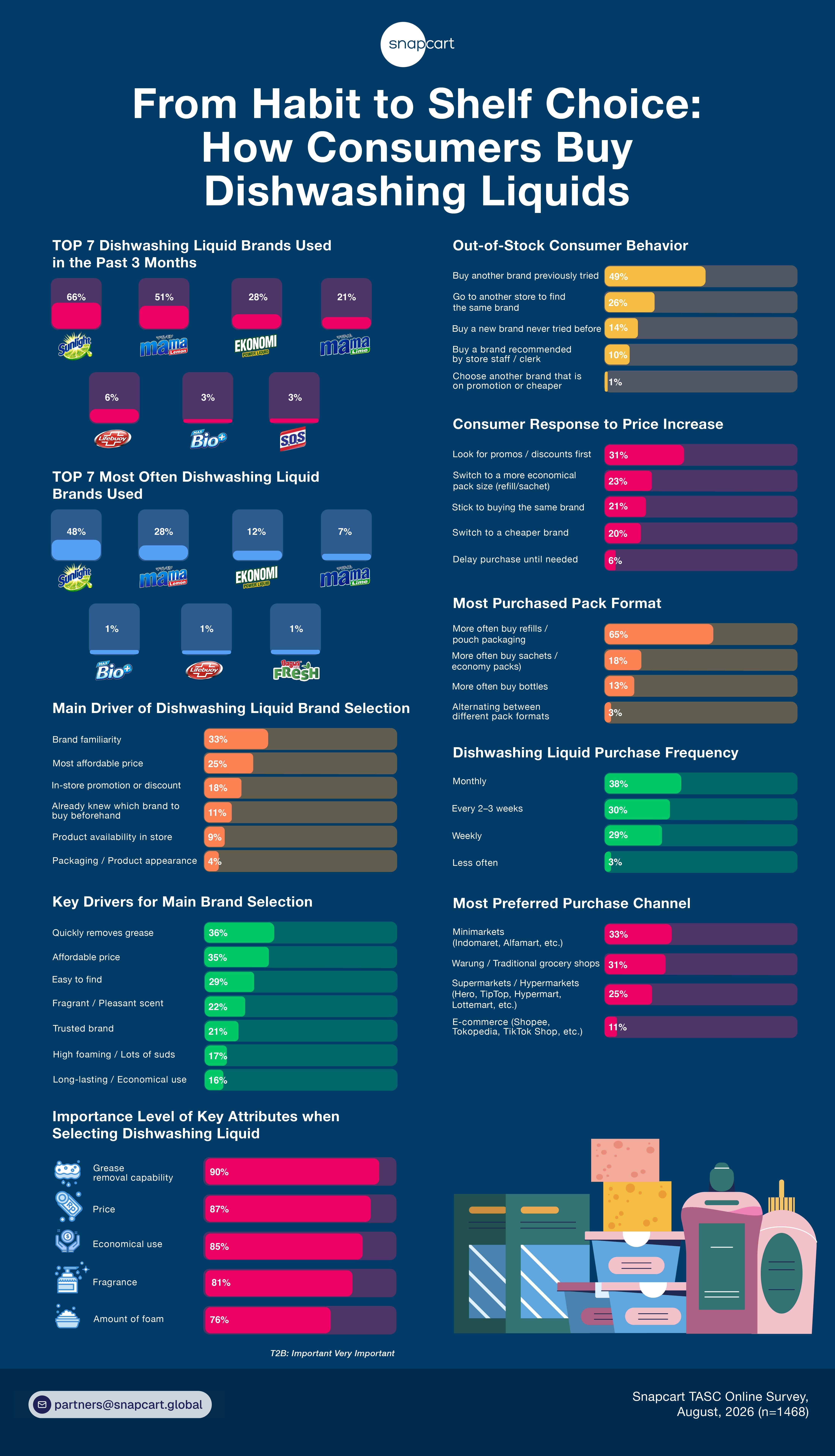
TOP 7 Dishwashing Liquid Brands Used in the Past 3 Months
Category penetration over a three-month window shows a highly consolidated market led by two main powerhouses. Sunlight leads category trial and penetration at 66%, followed by Mama Lemon at 51%. In the second tier, Ekonomi (28%) and Mama Lime (21%) hold solid market presence as strong alternative choices. Meanwhile, challenger or specialty brands like Lifebuoy, Bio+, and SOS capture under 10% reach each. This highlights a strong duopoly where smaller brands face steep competition to secure presence in consumer pantries.
TOP 7 Most Often Dishwashing Liquid Brands Used
When respondents select the brand they use most often, Sunlight leads primary brand choice at 48%, followed by Mama Lemon at 28% and Ekonomi at 12%. Mama Lime represents 7% of primary choice, while Bio+, Lifebuoy, and Bagus Fresh each account for 1%.
Comparing past-3-month penetration (Graphic 1) to primary brand usage (Graphic 2) shows that market share narrows toward top players, where Sunlight and Mama Lemon retain the largest proportion of core usage.
Main Driver of Dishwashing Liquid Brand Selection
At the point of sale, consumer choices are heavily driven by low-involvement habits and price sensitivity. Brand familiarity (being accustomed to using the brand) is the single largest purchase driver at 33%, showing that a third of consumers buy out of routine without active shelf evaluation. Direct financial factors play a secondary role, with affordable price (25%) and in-store promotions (18%) driving decisions. Together, brand familiarity and price-related incentives account for 76% of brand selections at retail.
Key Drivers for Main Brand Selection
When consumers evaluate why they choose their main brand, core functionality and affordability emerge as equal priorities. Quick grease removal (36%) and affordable price (35%) are the most frequently cited drivers, closely followed by distribution convenience (easy to find in stores at 29%). Secondary sensory and equity attributes like pleasant fragrance (22%), brand trust (21%), foam volume (17%), and economical usage (16%) serve as supporting criteria once baseline performance and affordability are met.
Importance Level of Key Attributes when Selecting Dishwashing Liquid
Evaluating absolute attribute importance confirms that consumer expectations are consistently high across all functional benchmarks. Grease removal capability leads with a 90% Top 2 Box (T2B) rating (rated as important or very important). Financial benchmarks score almost as high: Price (87% T2B) and Economical use (85% T2B) reflect strong category cost sensitivity. Sensory attributes like Fragrance (81% T2B) and Amount of foam (76% T2B) rank slightly lower but remain essential requirements for most consumers.
Out-of-Stock Consumer Behavior
On-shelf availability (OSA) directly influences brand protection. When facing an out-of-stock situation, 49% of respondents state they will switch to another brand they have previously tried. Only 26% exhibit store-switching loyalty to seek out the same brand elsewhere. In total, 74% of consumers substitute their purchase at the original retail location (buying a previously tried brand, trying an unfamiliar brand at 14%, or taking clerk advice at 10%), demonstrating that stockouts lead directly to lost sales and competitor trial.
Consumer Response to Price Increase
Price increases prompt active value-seeking behaviors. In response to price hikes, 31% of consumers first search for promotions or discounts, while 23% adjust by switching to a more economical pack size (refill or sachet). Combined, 54% of consumers adapt within the brand portfolio or promotional ecosystem before switching brands. Meanwhile, 21% remain price-inelastic and stick with the brand, while 20% switch directly to a cheaper competitor.
Most Purchased Pack Format
Packaging format usage is heavily skewed toward flexible, value-oriented formats. Refill / pouch packaging dominates as the primary format for 65% of respondents. Sachets and economy packs represent 18%, catering to cash-flow-sensitive daily buyers in traditional retail. Rigid bottle packaging accounts for only 13% of purchases, functioning primarily as an initial purchase before consumers transition to recurring pouch refills.
Dishwashing Liquid Purchase Frequency
Replenishment cycles indicate that dishwashing liquid is a high-velocity, consistent grocery staple. Monthly restocking represents the single largest frequency at 38%, matching planned family grocery shopping. Purchases every 2–3 weeks (30%) and weekly (29%) account for shorter refill cycles common in traditional neighborhood trade. Overall, 97% of consumers restock at least once per month, making the category a dependable driver of retail foot traffic.
Most Preferred Purchase Channel
Offline retail channels dominate primary purchase preferences for 89%. Minimarkets lead at 33% due to store proximity and convenience, closely followed by Warungs / Traditional grocery shops at 31%. Supermarkets / Hypermarkets capture 25% of preferred purchases for planned monthly restocking. Meanwhile, online platforms account for the remaining 11% of preferred purchase channels.
Key Takeaways
1. Prioritize Channel Distribution Across Both Minimarkets and Traditional Trade
Minimarkets (33%) and traditional warungs (31%) together represent 64% of primary channel choices. Aligning distribution strategies across both organized modern trade and general trade directly matches where the vast majority of consumers shop.
2. Focus Portfolio Assortment on Refill Pouches Across Replenishment Cycles
Refill pouches represent 65% of most purchased pack formats, far outperforming sachets (18%) and bottles (13%). Cross-analyzing this with purchase frequency shows that high weekly (29%), 2–3 week (30%), and monthly (38%) cycles make pouches the core volume driver across both modern and traditional retail.
3. Safeguard On-Shelf Availability (OSA) to Prevent Competitor Deflection
When facing an out-of-stock situation, 49% of consumers switch to a brand they have previously used. Because secondary options like Mama Lemon (51%), Ekonomi (28%), and Mama Lime (21%) already enjoy significant active reach in the market, market leaders face an immediate threat of shopper leakage whenever inventory runs out at the shelf.
4. Mitigate Price Elasticity via Pack Downsizing and Trade Promotions
In response to price hikes, 54% of consumers adapt within the brand portfolio, either by seeking promos (31%) or switching to smaller, more economical pack sizes (23%), before considering an outright brand switch (20%). Brands can protect volume by offering promotional multi-packs and flexible refill options rather than relying solely on list price increases.
5. Anchor Product Claims on Rapid Grease Removal and Overall Value
Grease removal capability achieves a 90% Top 2 Box importance rating (rated as important or very important) and is cited by 36% as the primary functional driver for main brand choice, alongside affordable price (35% driver, 87% T2B importance). Positioning campaigns should highlight fast grease-cutting performance and economy to overcome consumer purchase habits (33% brand familiarity selection).
Need to learn more about consumer habits and behavior? Contact us at partners@snapcart.global.