As digital media consumption continues to evolve, podcasting has emerged as a high-impact channel for brand storytelling and consumer engagement. To understand how modern audiences interact with sponsored content, Snapcart conducted an online survey in July 2026 (n = 615) examining listener demographics, platform habits, advertising receptivity, and purchase drivers. This article outlines the key survey findings and provides strategic insights for brands looking to maximize their podcast advertising effectiveness.
Platform Dominance
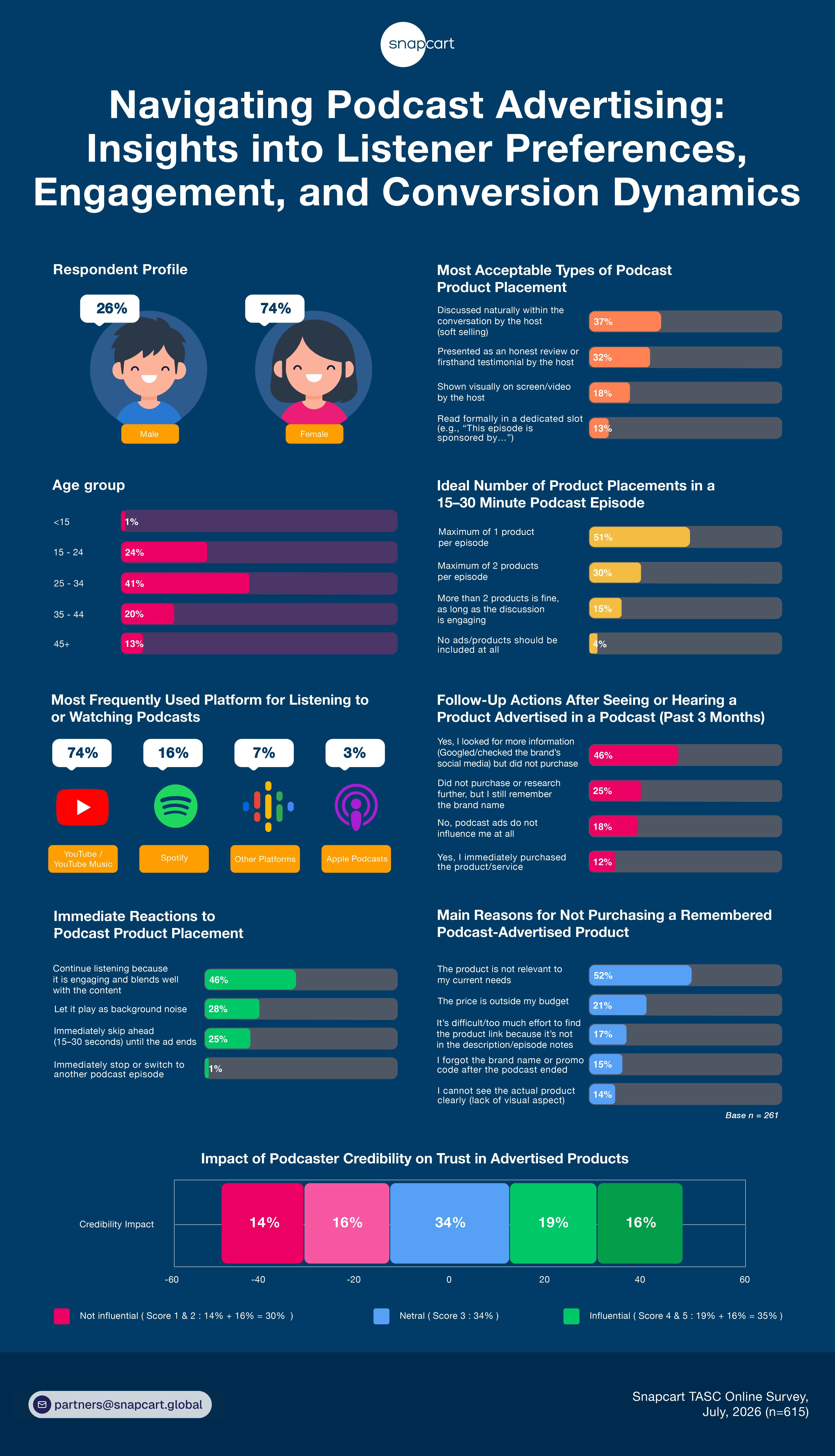
Where and what audiences listen to play a foundational role in campaign reach and media selection. Video-enabled podcast consumption currently dominates the landscape, with YouTube/YouTube Music serving as the runaway leader, utilized by 74% of respondents as their primary podcast platform. Audio-first pioneer Spotify follows at 16%, while Other Platforms (7%) and Apple Podcasts (3%) capture niche segments.
Immediate Reactions to Podcast Product Placement
Podcast advertising benefits from remarkably high listener tolerance compared to traditional digital media formats. When a product placement occurs, 46% of respondents choose to continue listening as long as the delivery is engaging and seamlessly blended into the episode content. Another 28% let the advertisement play as background noise without actively skipping. On the other hand, active ad avoidance remains relatively low, with only 25% of listeners immediately skipping ahead (15–30 seconds) until the ad ends, and an absolute minority of 1% stopping or switching to another episode entirely. Combined, a substantial 74% of the total audience allows product placements to play out.
Host Credibility & Preferred Product Placement Styles
How a sponsor message is delivered directly impacts brand perception and acceptance among audiences. When evaluating the impact of podcaster credibility, 31% of listeners view it as highly influential (Top 2 Box rating of 4 or 5 out of 5), 34% express neutral sentiment (rating 3), and 35% view it as less influential (Bottom 2 Box rating of 1 or 2). Furthermore, audiences heavily favor native, conversational integration over scripted commercial breaks. 37% prefer soft-selling approaches where products are discussed naturally within the conversation by the host, while 32% favor honest reviews or firsthand testimonials. Meanwhile, 18% prefer products showcased visually on screen by the host, and only 13% prefer traditional, formal sponsor reads, such as “This episode is sponsored by…”
Optimal Ad Frequency in Episodes
Ad fatigue poses a real risk when over-saturating episode runtimes with commercial messages. When asked about ideal product placement limits for standard 15–30 minute podcast episodes, 51% of respondents state that a maximum of 1 product placement per episode is ideal, while 30% deem a maximum of 2 product placements acceptable. A smaller group of 15% does not mind having more than two products as long as the discussion remains engaging, and only 4% prefer episodes with no product placements at all. Overall, a clear majority of 81% of listeners favor limiting sponsorships to 1 or 2 products per 15–30 minute episode.
Consumer Follow-Up Actions Post-Exposure
Podcast advertising demonstrates strong brand awareness and intent generation, even if immediate conversions require longer sales cycles. Following exposure to an ad in the past three months, 46% of respondents actively searched for more information, such as Googling or checking the brand’s social media, though they did not purchase right away. An additional 25% did not research immediately but retained clear brand name memory, while 12% made an immediate purchase. Only 18% reported that podcast ads do not influence them at all. Collectively, 83% of respondents retained brand recall or initiated intent-based actions following podcast ad exposure.
Main Barriers to Conversion
For listeners who remembered a product but refrained from buying, key barriers highlight operational and contextual friction points across the funnel. The single largest obstacle is relevance, with 52% stating the product was not relevant to their current needs, followed by price, where 21% felt the cost was outside their budget. Operational hurdles also play a major role, as 17% found it difficult or too much effort to find the product link because it was missing from the description or episode notes. Additionally, 15% simply forgot the brand name or promo code after the episode ended, and 14% could not see the actual product clearly due to a lack of visual presentation.
Key Insights
1. Seamless Soft Selling Outperforms Scripted Reads
Consumers heavily favor natural, organic ad integrations over rigid sponsorship announcements. 37% of respondents prefer soft selling integrated into conversational banter, and 32% value personal host reviews, whereas only 13% prefer formal, scripted ad reads. Brands should empower podcast hosts to speak authentically about products rather than reciting strict scripts.
2. High Intent, Delayed Conversion Window
Podcast advertising excels at sparking curiosity and brand recall, even if immediate conversion is modest. While 12% of respondents purchased products immediately, a substantial 46% conducted follow-up research on search engines or social media, and 25% retained brand memory. Marketers must build multi-touch retargeting campaigns to capture this high-intent research phase.
3. Video-First Platforms Dominate the Podcast Hierarchy
74% of listeners consume podcast content through YouTube/YouTube Music, vastly outstripping audio-only platforms like Spotify (16%) and Apple Podcasts (3%). This underscores a fundamental shift toward visual podcasts, where showing physical products on screen (18% acceptance) enhances brand perception and engagement.
4. Overcoming “Friction at the Finish Line” is Critical
A notable portion of potential sales is lost due to preventable User Experience (UX) obstacles. Nearly 46% of cumulative drop-off reasons stem from logistical hurdles, such as missing or hard-to-find links in episode descriptions (17%), forgotten promo codes (15%), and poor visual product exposure (14%). Advertisers and creators can boost conversion rates simply by placing clear, clickable links and promo codes prominently in the show notes and pinned comments.
Need to learn more about consumer habits and behavior? Contact us at partners@snapcart.global.